
LATEST NEWS


















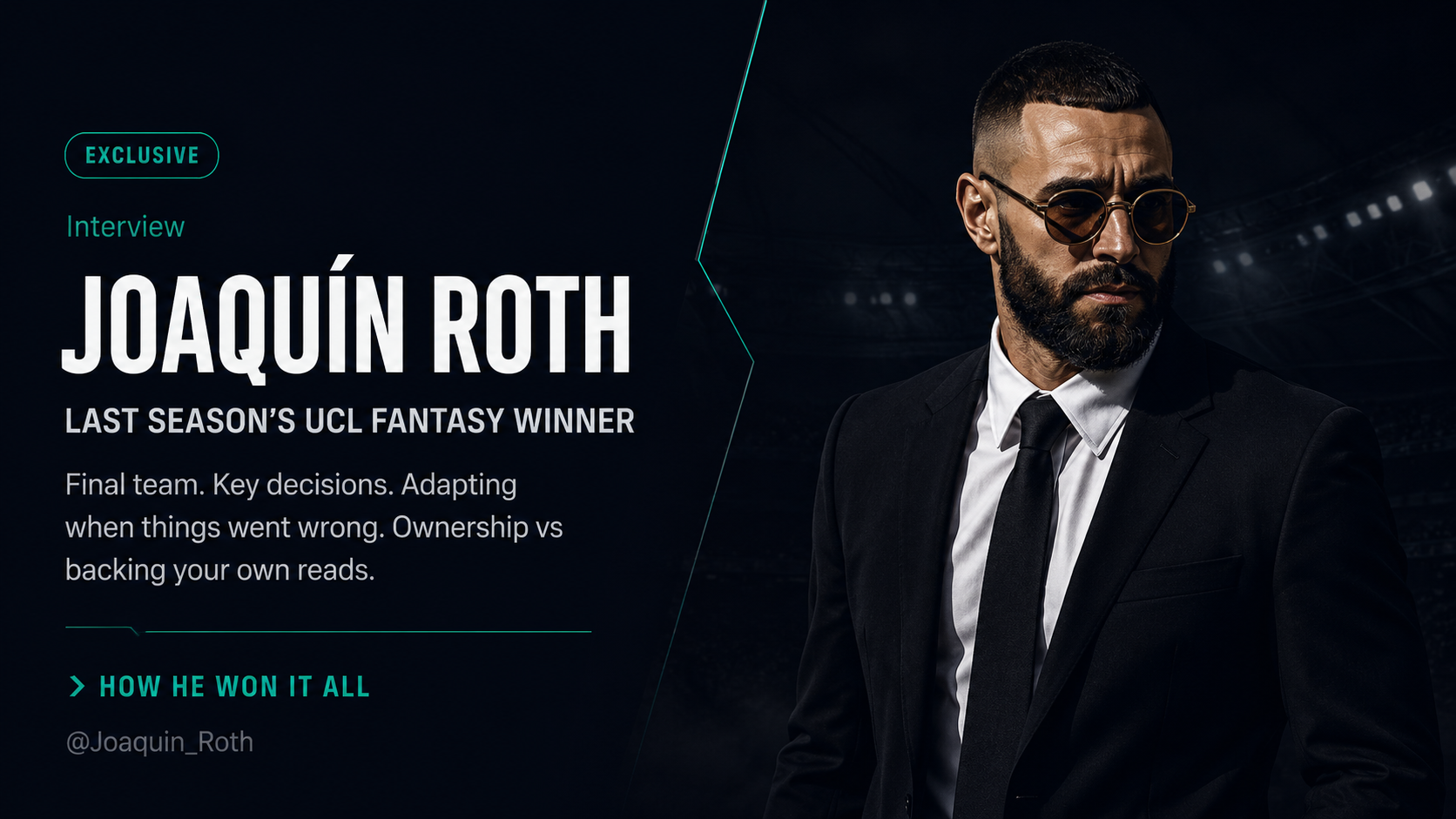
Exclusive Interview: Joaquin Roth, Last Season’s #1 UCL Fantasy Winner
What does it actually look like to win UCL Fantasy? We asked Joaquin Roth, the #1 overall winner from last season, to walk through the final winning team, the season-long habits that mattered most, and how he handled the moments when everything threatened to swing away from him.
Evergreen strategy pieces are only useful if they still hold up when the noise gets loud. That is why this interview matters. Joaquin’s answers are not about magic tricks or hindsight theatre. They are about structure, discipline, and making one clear read at the right time.
Below is our exclusive interview with the reigning #1 overall winner from last season’s UCL Fantasy game.
Q: Can you walk me through your final winning team and why you picked those players?
Joaquin Roth: “My final team looked like this:
Joaquin Roth’s final winning team
- Goalkeeper Donnarumma
- Defenders Nuno Mendes, Hakimi, Dumfries
- Midfielders Vitinha, Kvara, Dembélé (C), Çalhanoğlu
- Forwards Doué, Thuram, Lautaro Martínez
“Going into the final, I made a very conscious decision to trust my gut; I strongly felt PSG would win the game. From there, it was about building around that read while still protecting myself against downside scenarios.
“I doubled and tripled on PSG where I expected control and attacking output, and then complemented the team with Inter assets who could realistically return even in a losing effort: players like Dumfries for attacking threat, Çalhanoğlu for penalties, and both forwards, who were the most owned and most dangerous picks from their side.
“At that stage of the competition, I thought it was less about being creative and more about making a clear call and committing to it with a coherent structure.”
Our take: this is such an important final-week lesson. Joaquin did not build a scattered hedge team. He made a strong read on PSG, then used Inter picks selectively where the floor and damage protection still made sense. That is not fence-sitting. That is smart scenario planning.
Q: What key decisions or patterns do you think made the biggest difference over the whole season?
Joaquin Roth:
- “Playing the long game with transfers, especially around the knockout stages. Managing the limited free transfers across legs and rounds was key. I always tried to balance upside with the need to avoid being left with eliminated players.”
- “Prioritising having active players, it sounds simple, but consistently fielding 13 to 15 players deep into rounds is massively underrated. Many ranks are lost by carrying dead spots.”
- “Understanding match context over raw form. Knockout football is a different game. Home advantage, game state, and urgency often matter more than underlying stats.”
- “Selective differentials, not forced ones. Players like Lookman or Bellanova weren’t picked to be different, but because they made sense within the structure. The points they delivered ended up being huge swings in early stages for me.”
- “Discipline over reaction, something I always try to say on my threads, and avoiding panic transfers. Sticking to a plan, even after setbacks, was probably the most important trait across the season.”
Our take: there is a lot in there, but two lines really stand out. The first is “active players”. That sounds obvious until you realise how many seasons are quietly damaged by carrying dead spots too long. The second is “selective differentials, not forced ones”. That is elite fantasy language. Great managers do not chase differentials for social credit. They pick them because the structure justifies them.
The season-long themes behind a winning campaign
- Transfers Planned across rounds, not just fixtures
- Squad health Active players matter more than pretty benches
- Knockout reading Match context can beat raw form
- Differentials Chosen for fit, not novelty
- Mental game Discipline beats emotional reaction
Q: Were there any moments where things went against you, and how did you adapt your strategy?
Joaquin Roth: “To be honest, this is something you feel all the time, but it becomes much more real in the latter stages when you’re actively tracking your rank and realizing what’s at stake.
“One key moment was the quarter-final second leg. I sold Guirassy before Barcelona and he went on to score a hat-trick, 17 points. In the same round, I also moved away from Kane, who returned as well. That was a huge swing and, in hindsight, a moment where the season could have been wrapped up much earlier.
“Instead of overreacting, I tried to zoom out and recalibrate, accepting variance as part of the game, refocusing on structure rather than individual outcomes and sticking to the same principles that got me there in the first place.
“At that stage, chasing those lost points aggressively usually leads to more mistakes. The key was staying composed, trusting the process, and letting the game come back rather than forcing it.”
Our take: this might be the most valuable answer in the whole interview. Everyone wants to study the winning picks. Far fewer want to study the emotional control that stops a season imploding after a brutal swing. Joaquin’s point is dead right: the instinct to “win it back immediately” is where good ranks often get broken.
Q: How do you balance ownership vs backing your own reads when making transfers and captain picks?
Joaquin Roth: “Throughout the season, I leaned heavily on my gut, but in a structured way.
“A good example was playing an early WC2 after watching Raphinha live; I felt there was something there before it became obvious, and that decision shaped a big part of my team going forward. The same applies to players like Lookman or Bellanova, who weren’t template picks but delivered beyond expectations.
“That said, it’s never about ignoring ownership completely. It’s more about knowing when ownership matters, especially in later stages, understanding which players you must cover versus where you can gain, and also building a team where your differentials are intentional, not random.
“On captaincy, I tend to be relatively conservative.
“In my threads I often talk about backing reliable, high-involvement attackers and avoiding unnecessary punts when effective ownership is high, like captaining defenders. Captaincy is one of the biggest levers in the game, so while there’s room for boldness, I generally prefer controlled risk. Over a full season, that balance between conviction and discipline is what keeps you consistently moving forward.”
Our take: that phrase, “my gut, but in a structured way”, is probably the cleanest summary of high-level fantasy decision-making you will hear. This is not blind instinct. It is informed conviction. Ownership matters, of course, but only in the right places. Joaquin’s distinction is excellent: know which players you have to respect, and separate those from the slots where you are actually free to attack.
The captaincy answer is just as strong. There is a temptation in fantasy content to glamorise chaos, but over a full season, most elite finishes are built on controlled aggression, not endless hero punts. Backing reliable, high-involvement attackers and staying disciplined when effective ownership is high is a very hard habit to fake over time.
Joaquin Roth on ownership and captaincy
- Ownership Respect it, but do not worship it
- Differentials Intentional, not random
- Captaincy Reliable, high-involvement attackers first
- Risk style Controlled risk over vanity punts
The evergreen takeaway
If you strip this interview down to its core, Joaquin’s winning season was built on a handful of habits that travel well across formats and years: keep your squad alive, manage transfers with the long game in mind, read the match rather than just the spreadsheet, choose differentials with purpose, and do not let one painful round hijack your process.
That is what makes this evergreen. The names will change. The fixtures will change. The emotional traps will not.
And that is exactly why listening to the #1 winner from last season is worth your time.